 Shakesphere
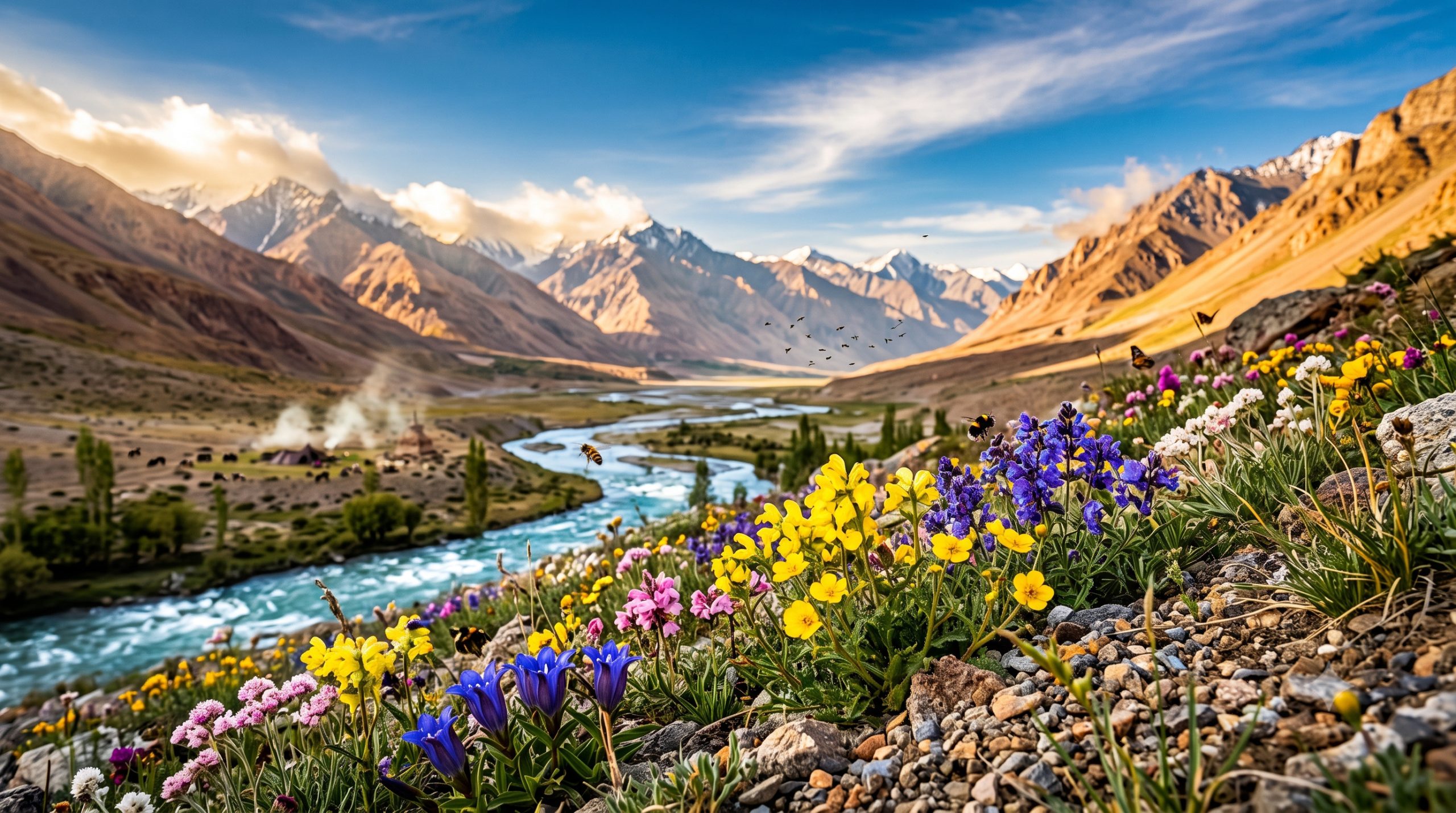
Ladakh is often described as a barren high-altitude desert, but its plant life tells a more complicated story. A 2023 scientific checklist of the region’s vascular flora records 1,810 taxa representing 1,702 species in 530 genera and 91 families. Most are herbs, and many survive in places that look almost empty from a road: gravel fans, stream edges, alpine turf, wet ground below snowmelt, irrigated village margins and sheltered cracks in rock.
For visitors, the practical wildflower season is short. July and August are usually the strongest months for seeing a broad range of alpine and high-altitude flowers, although timing changes with elevation, snowmelt, moisture and the year’s weather. Lower valleys can start earlier; exposed high ground can flower later. If your goal is to photograph flowers with names rather than simply see colour in the landscape, it helps to treat Ladakh as a set of small habitats rather than one single “bloom season.”
Flora of Ladakh at a glance
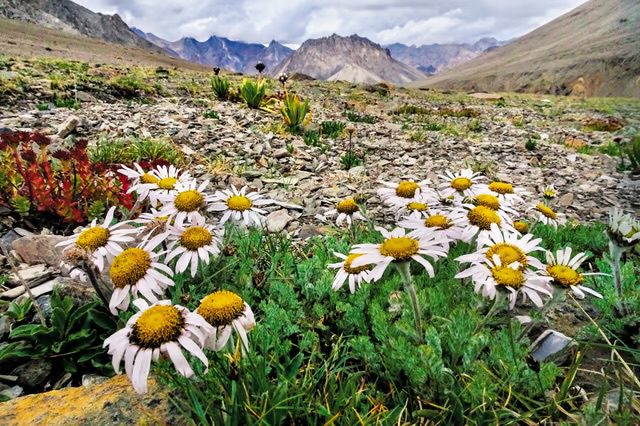
The word flora means the plant life of a place, so the flora of Ladakh includes much more than conspicuous flowers. The 2023 checklist includes flowering plants, gymnosperms and ferns. Of the 1,810 recorded taxa, 1,772 are angiosperms, while the flora as a whole is dominated by herbs. Asteraceae and Poaceae are the two largest families in the checklist.
That newer total is higher than figures found in older books and articles. This does not automatically mean the older work was wrong. Different publications use different boundaries, taxonomic treatments and plant groups, and the 2023 checklist incorporated field surveys, herbarium work and a broad literature review. For a current overview, it is the most useful baseline we have found.
- 1,810 vascular-plant taxa are recorded in the 2023 regional checklist.
- 1,702 species are represented.
- 530 genera and 91 families are included.
- 1,668 taxa are herbs, reflecting the importance of herbaceous plants in this cold, dry, high-altitude environment.
- Asteraceae is the largest family in the checklist, followed by Poaceae.

Flowers found in Ladakh: names to know
Searches for “flowers of Ladakh with name” often lead to lists that mix confirmed Ladakh records, cultivated ornamentals and plants from other parts of the Himalaya. The species below are all present in established Ladakh checklists. This is not a list of the “most common” flowers, because abundance varies strongly by habitat and location. It is a practical starting set of names for travellers, photographers and students.
| Scientific name | Useful recognition or group | Why it is worth knowing |
|---|---|---|
| Meconopsis aculeata | Himalayan blue poppy | A confirmed Ladakh record and one of the region’s most searched blue-flowered plants. |
| Primula macrophylla | Primrose group | One of several Primula species recorded from Ladakh. |
| Gentiana hugelii | Gentian group | Part of a diverse set of blue and violet gentians recorded in the region. |
| Aconitum violaceum | Aconite / monkshood group | Recorded in Ladakh; do not handle or use wild aconites medicinally. |
| Arnebia euchroma | Boraginaceae herb | A documented Ladakh plant with a long history of ethnobotanical interest. |
| Lloydia serotina | Small alpine lily relative | Confirmed in the Ladakh checklist and characteristic of cold mountain habitats over a much wider range than Ladakh alone. |
| Potentilla bifurca | Cinquefoil group | One of many Potentilla taxa recorded in Ladakh. |
| Aquilegia fragrans | Fragrant columbine | Recorded from Ladakh and associated with relatively moist mountain habitats. |
| Iris hookeriana | Iris | One of the iris species included in the Ladakh checklist. |
| Rosa webbiana | Wild rose | A familiar pink-flowered shrub recorded across the region. |
| Saussurea glacialis | Saussurea group | One of numerous high-altitude Saussurea taxa recorded in Ladakh. |
| Leontopodium leontopodinum | Edelweiss genus | One of several Leontopodium species recorded in Ladakh; European Alpine edelweiss terminology should not be used as a catch-all identity for Ladakhi plants. |
A useful caution: a plant can be characteristic of Ladakh without being endemic to Ladakh. Presence in a Ladakh checklist is not evidence that a species occurs nowhere else. Claims such as “endemic,” “rare,” “threatened” or “endangered” should be checked species by species against current taxonomic and conservation sources.

When is the best time to see wildflowers in Ladakh?
July and August are the safest general answer for travellers hoping to see a broad range of Ladakh wildflowers. High-altitude vegetation has a compressed growing season, and published work on Trans-Himalayan vegetation describes July–August as the main period when many species are in full bloom. The exact peak moves with altitude and snowmelt, so no single week is guaranteed across the whole region.
| Period | What to expect |
|---|---|
| April | Apricot blossom in lower settlements and valleys can be a major floral event, but it is not the main alpine-wildflower season. |
| Late May to June | Earlier flowers begin appearing in lower and wetter ground as temperatures rise and snowmelt supplies moisture. |
| July to August | The most reliable broad window for alpine and high-altitude wildflowers across trekking country. |
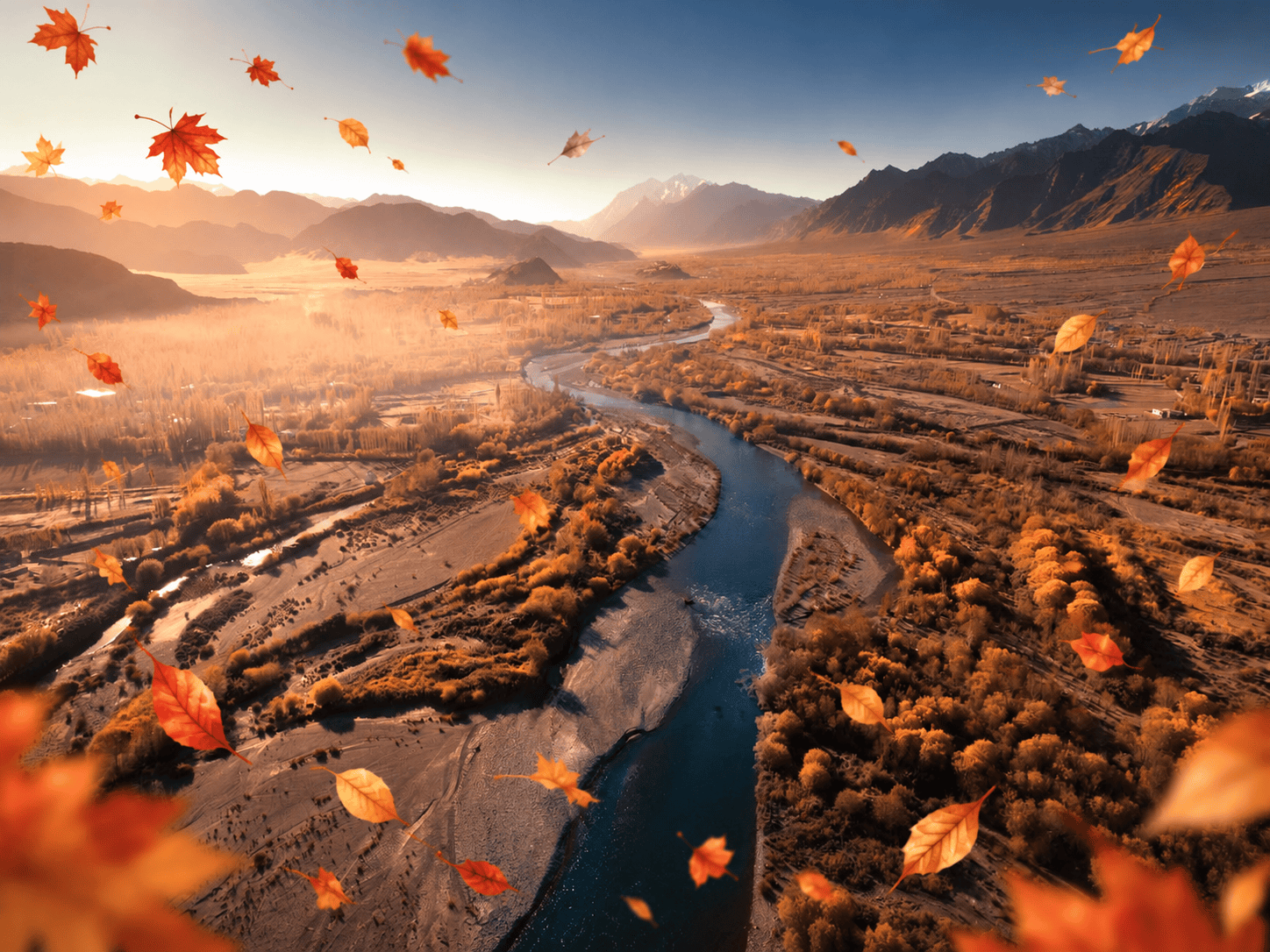
| September | Some species continue flowering, but many high-altitude plants are already moving into fruit or senescence. Cultivated flower fields near Leh can follow a different timetable. |
| October | Not a general wildflower month, although managed floriculture projects can still have scheduled blooms. |
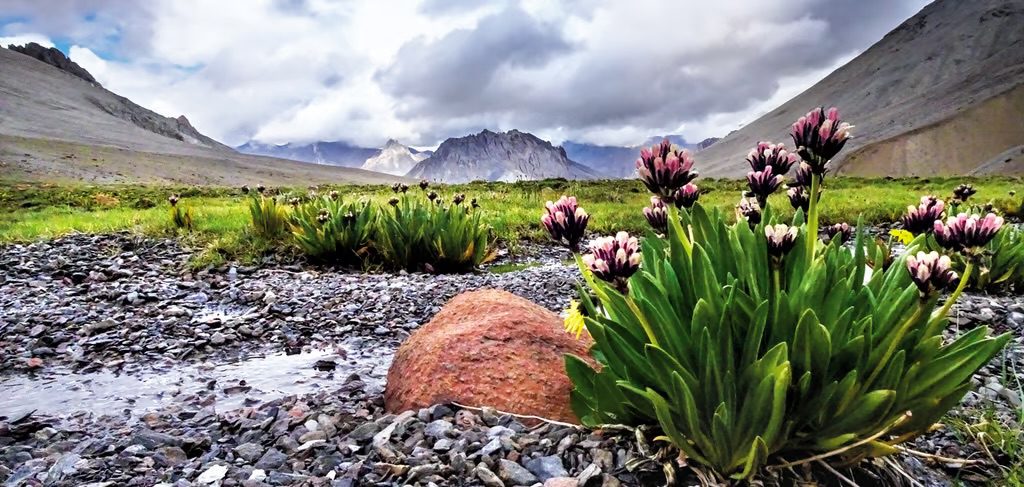
For photographers, a better question than “Which month?” is “Which elevation and habitat?” A stream-fed meadow at one altitude may be green and flowering while a dry slope a few kilometres away is already brown. A high pass can be weeks behind the Indus Valley.
Where to look for wildflowers in Ladakh
Leh and the Indus Valley
Around Leh, Shey, Thiksey, Stakna and neighbouring villages, irrigation channels, river margins, fields and side valleys create wetter microhabitats inside the cold desert. These are useful places to start looking without committing to a long trek. Remember that agricultural and garden plants are mixed with genuinely wild species here.
Markha Valley
The Markha route crosses dry slopes, villages, river edges, pasture and higher alpine ground. That variety is more important botanically than the name of the trek itself. Look carefully along moist margins and near side streams rather than expecting a continuous carpet of flowers.
Nubra Valley
Nubra combines very dry terrain with river systems, cultivated settlements and greener side valleys. Wild roses, irises and many herbaceous plants may occur in suitable habitats, but flowering conditions vary sharply from place to place.
Changthang and the Tso Moriri region
High-altitude steppe, wetlands and moist ground around streams can support small, low-growing plants that are easy to miss. In fragile wetland and pasture habitats, observation from existing tracks is preferable to walking directly through flowering patches.
Zanskar and Suru
The western and southern parts of Ladakh can have a different moisture regime from the driest areas around Leh. Summer trekking routes through Zanskar and Suru pass through a wide range of elevations and can be especially rewarding for people interested in plant photography.

Why high-altitude plants in Ladakh look different
Ladakh’s plants deal with cold nights, intense sunlight, wind, short growing seasons and limited water. There is no single “high-altitude adaptation,” but several forms appear repeatedly: low growth close to the ground, compact or cushion-like forms, hairy or thick leaves, strong root systems and rapid flowering when moisture and temperature allow.
Microhabitat matters enormously. Meltwater can turn a narrow strip of ground into a green corridor. A boulder can reduce wind exposure. A north-facing hollow may hold moisture longer than a nearby slope. Irrigation around villages creates another set of conditions entirely. This is why the flora of Ladakh cannot be understood from the colour of the mountains alone.
Wildflowers are not the same as Ladakh’s new flower fields
In 2026, Ladakh added a completely different kind of flower attraction near Leh: large managed floriculture fields at Choglamsar and Stakna. The Ladakh Administration says the twin project sits at about 10,600 feet and includes large-scale plantings of Lilium and Gladiolus. Choglamsar’s first 2026 bloom began in early September, while the Stakna planting followed its own managed schedule.
These fields are important for local floriculture and are visually striking, but they should not be confused with Ladakh’s wild flora. Lilium and Gladiolus planted for commercial cultivation are not evidence of what grows wild on a nearby mountain slope. For travellers, the distinction is useful: visit the managed flower fields as a new agricultural and tourism project, and look for wild plants in natural habitats on a separate basis.
Wildflowers, medicinal plants and Amchi knowledge
Plants are deeply connected with Ladakh’s traditional knowledge systems, including Sowa-Rigpa and local Amchi practice. Some plants documented in botanical and ethnobotanical literature have traditional uses, but that does not make wild plants safe for self-medication. Identification mistakes can be serious, and some high-altitude plants, including aconites, can be toxic.
The most respectful approach for a visitor is to photograph and learn rather than collect. Medicinal use, harvesting and local names are best understood through qualified practitioners and botanists, not through a short online list.
How to identify a Ladakh flower from a photo
If you have a photograph and want a name, start with more than flower colour. Record the location, approximate elevation, habitat, month, leaf shape, plant height and whether the plant was growing in wet ground, gravel, pasture or a cultivated area. Those details can separate species that look similar in a single close-up.
Two especially useful references are the Flowers of India Ladakh checklist and the locally produced Plants of Ladakh: A Photographic Guide by botanist Konchok Dorjey and Phuntsog Dolma. The latter was developed from fieldwork across Ladakh and presents nearly two hundred plant species in an accessible photographic format.
The photographs on this page are LIFE on the PLANET LADAKH field photographs. Where species-level identification has not been independently confirmed, the captions describe the habitat or flower form rather than assigning a scientific name. That is more useful than attaching a confident but unreliable label.
How to see flowers without damaging them
- Stay on existing trails where possible, especially in wet meadows and soft alpine turf.
- Do not pull up plants, roots, bulbs or seed heads for identification.
- Photograph a plant in place and include leaves and surrounding habitat, not only the flower.
- Avoid flattening a patch while setting up a camera or tripod.
- Do not assume a medicinal plant is safe to touch, taste or collect.
- In pasture and village land, remember that apparently “empty” ground may still be actively used.

Frequently asked questions about the flora of Ladakh
What are some flowers found in Ladakh with names?
Confirmed Ladakh records include Meconopsis aculeata, Primula macrophylla, Gentiana hugelii, Aconitum violaceum, Arnebia euchroma, Lloydia serotina, Potentilla bifurca, Aquilegia fragrans, Iris hookeriana, Rosa webbiana and many species of Saussurea and Leontopodium.
How many plant species are there in Ladakh?
The 2023 updated vascular-flora checklist records 1,810 taxa, including 1,702 species, from 530 genera and 91 families. This is a vascular-flora total, not a count of showy wildflowers alone.
Which month is best for wildflowers in Ladakh?
July and August are the best general window for a broad range of high-altitude flowers. Lower areas can start earlier, and higher sites may peak later depending on snowmelt and moisture.
Are all unusual flowers in Ladakh endemic?
No. Many plants recorded in Ladakh also occur elsewhere in the Himalaya, Tibetan Plateau, Central Asia or other mountain regions. “Endemic” should be used only when a reliable distribution source shows that a taxon is restricted to a defined area.
Is the Himalayan blue poppy found in Ladakh?
Yes. Meconopsis aculeata is included in established Ladakh plant checklists. It is a genuine Ladakh record, although seeing it on a particular trek is never guaranteed.
Is Edelweiss found in Ladakh?
Several species of the genus Leontopodium are recorded in Ladakh, including Leontopodium leontopodinum, L. monocephalum, L. nanum, L. ochroleucum and L. pusillum. Species-level identification is better than applying a European Alpine name to every Ladakhi edelweiss-like plant.
Are the Choglamsar and Stakna flower fields wildflower meadows?
No. They are managed high-altitude floriculture projects. The 2026 plantings include large numbers of cultivated Lilium and Gladiolus. They are a new visitor attraction and agricultural initiative, but they are separate from Ladakh’s natural wildflower habitats.

 Shakesphere